
Videos & Resources
Videos & Resources
Need help? Check out the below resources to help on your financial journey.
Need help? Check out the below resources to help on your financial journey.
Providing the nuanced perspective that tends to be missing in wealth management.
Most of the tax planning that actually matters for high earners has a December 31 deadline, not an April 15 one. By the time you meet with your accountant in the spring, the year is closed and they are mostly recording what already happened.
Ask a lender how much house you can buy and the number they give you is almost always higher than what you should actually spend. In this video I walk through the 5 tests I use with clients to land on a real home budget, using a couple earning $360,000 a year as the example. The bank would approve them for about $2.25M. The tests put them closer to $1.4M.
Lending money to your kids can be one of the smartest things a family does, or a gift tax problem you did not see coming. An intrafamily loan lets you act as the bank for your children, charge the minimum interest rate the IRS allows, and keep the interest inside the family instead of paying it to a lender. Done right, it can also move future growth out of your taxable estate with no mortality risk.
In 2000, a Tax Court case involving a member of the Walton family made it possible to hand your children the upside on an asset while reporting a taxable gift of essentially zero. That structure is the grantor retained annuity trust, or GRAT, and it is now one of the most widely used advanced estate planning techniques in the country.
You can give your house to your children today, keep living in it rent free for the next 10 or 15 years, and report the gift to the IRS at a fraction of what the home is actually worth. That is a qualified personal residence trust, or QPRT, and it is one of the few estate planning strategies that works better when interest rates are higher.
Almost everyone planning for retirement has heard of the 4% rule. Save a nest egg, withdraw 4% in year one, adjust for inflation after that, and in theory you never run out of money. But the rule was built in 1994, its own creator now says it may be too conservative, and one of the most respected research firms in the country says it may be too aggressive.
I cover protective puts and what a year of downside protection really costs, why a covered call is not a hedge no matter how it gets sold to you, how a collar gets built for close to no cash out of pocket and why banks will lend against one, prepaid variable forwards for getting cash today without a sale, and the two tax deferred routes to real diversification: exchange funds and the newer Section 351 ETF conversions.
Buy real estate, run a cost segregation study, take a giant depreciation deduction, wipe out the tax on your income. You have heard some version of that pitch. What almost nobody leads with is that for most high earners the deduction is not reduced, it is unusable.
n this video I walk through what you are actually buying, what the return data shows once you pick a fair benchmark, why the low volatility on your statement is partly an illusion, what the current slowdown in distributions is costing investors, what the fees really add up to, and a simple framework for deciding whether a buyout fund belongs in your personal portfolio.
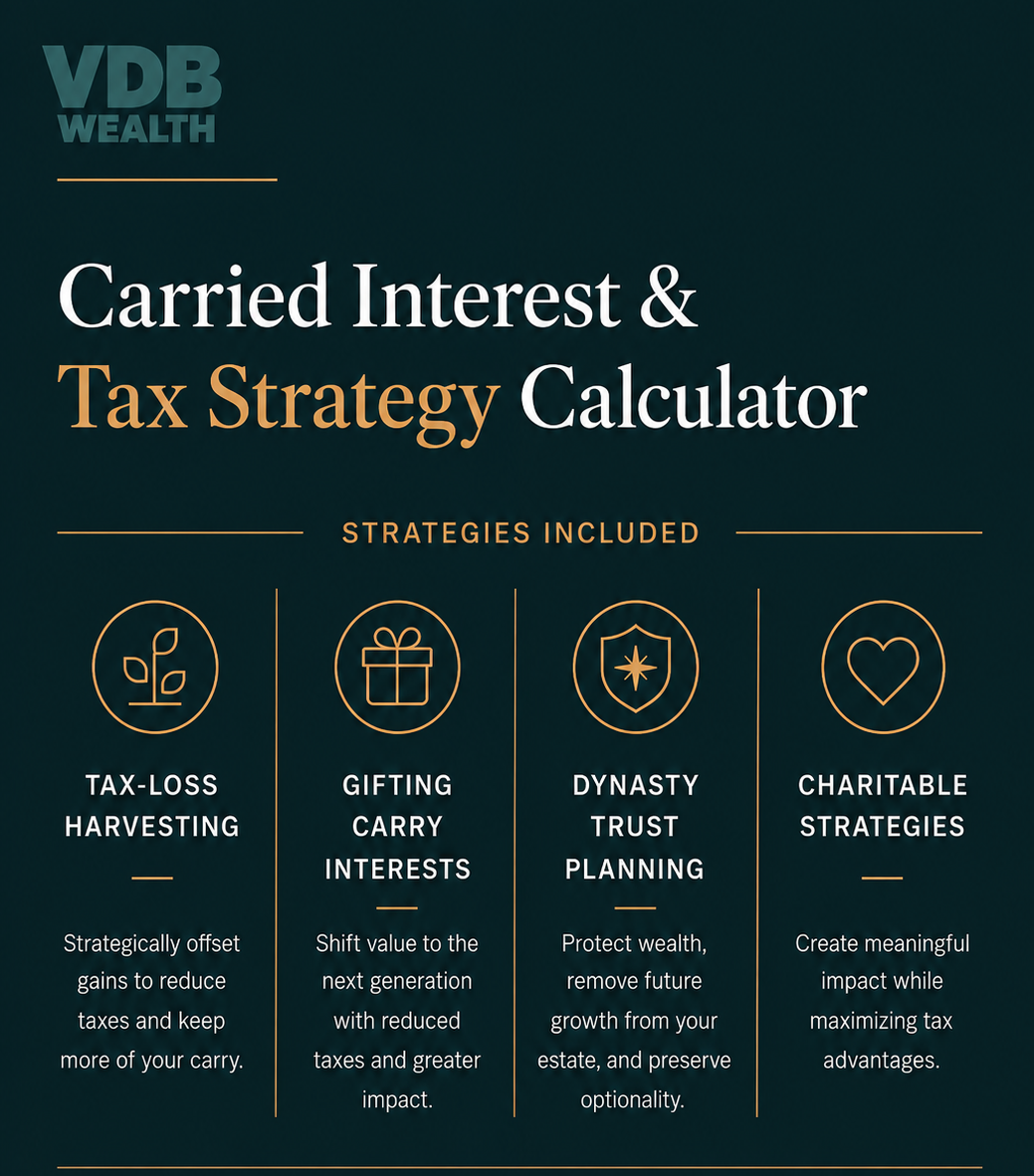
Calculate your potential tax savings from tax loss harvest or estate strategies on you carry
Get the Resource
Learn smart strategies to reduce your tax bill and keep more of what you’ve built. Tools and techniques to help business owners maximize their proceeds when selling.
Get the ResourceWe work with a select group of clients to provide tailored, high-touch wealth management. Ready to see how we can help?
Our personalized process ensures you receive expert financial guidance tailored to your unique goals. Get in touch in the way that works best for you—fill out the contact form, send us an email, or schedule a call. However you choose to reach out, we’re here to help you build, grow, and protect your wealth.
VDB Wealth LLC is a registered investment adviser located in the State of Georgia. Registration as an investment adviser does not imply a certain level of skill or training.
The information on this website is for informational purposes only and does not constitute investment, legal, tax, or financial advice. Nothing on this site should be interpreted as a solicitation, offer, or recommendation to buy or sell any securities or investment products. All investments involve risks, including the potential loss of principal.
VDB Wealth LLC provides investment advisory services only to residents of states where it is properly registered or exempt from registration. Past performance is not a guarantee of future results.
VDB Wealth LLC | (415) 209-5862 | contact@vdbwealth.com