
.png)

The Stories We Tell Ourselves: I’ve realized that being a wealth manager is as much about emotions as it is numbers. The numbers are sometimes the easy part. The harder part is understanding the stories we all tell ourselves about money.
These stories start when we’re young and are reinforced by our families, friends, and the communities we surround ourselves with. Sometimes they’re incredibly helpful. They create goals and motivate us to save, work hard, and build a better life.
But, they can also create a tremendous amount of pressure when the story starts interfering with our actual long-term goals.
I’ll use myself as an example. I tell myself that my kids need to go to great private schools. Why? I had an incredible experience at my school and my parents always prioritized education. Growing up, I constantly heard some version of:
“Education is the best investment you can make in your kids.”
Don't get me wrong, this is a great lesson. I’m grateful my parents taught it to me. But somewhere along the way, “education is important” turned into “my kids need to go to the best private schools.”
If I take a step back, is it actually true that my kids need to attend an expensive private school to get a great education and have a successful life? Probably not.
Now imagine private school doesn’t fit within my family’s financial plan. Am I actually willing to change my mind? That’s where this gets hard.
Everyone has their own version of these stories:
None of these things are inherently good or bad. Private school can be amazing. Camp can change a kid’s life. You may be a car guy/gal.
As with almost everything in life, the important thing is just recognizing the story and understanding how it's impacting your decisions. Is it because you’ve consciously decided this is something you value and you’re willing to make the necessary tradeoffs?
Or are you following a story someone else wrote for you 30 years ago? That’s where I think good financial planning gets interesting.
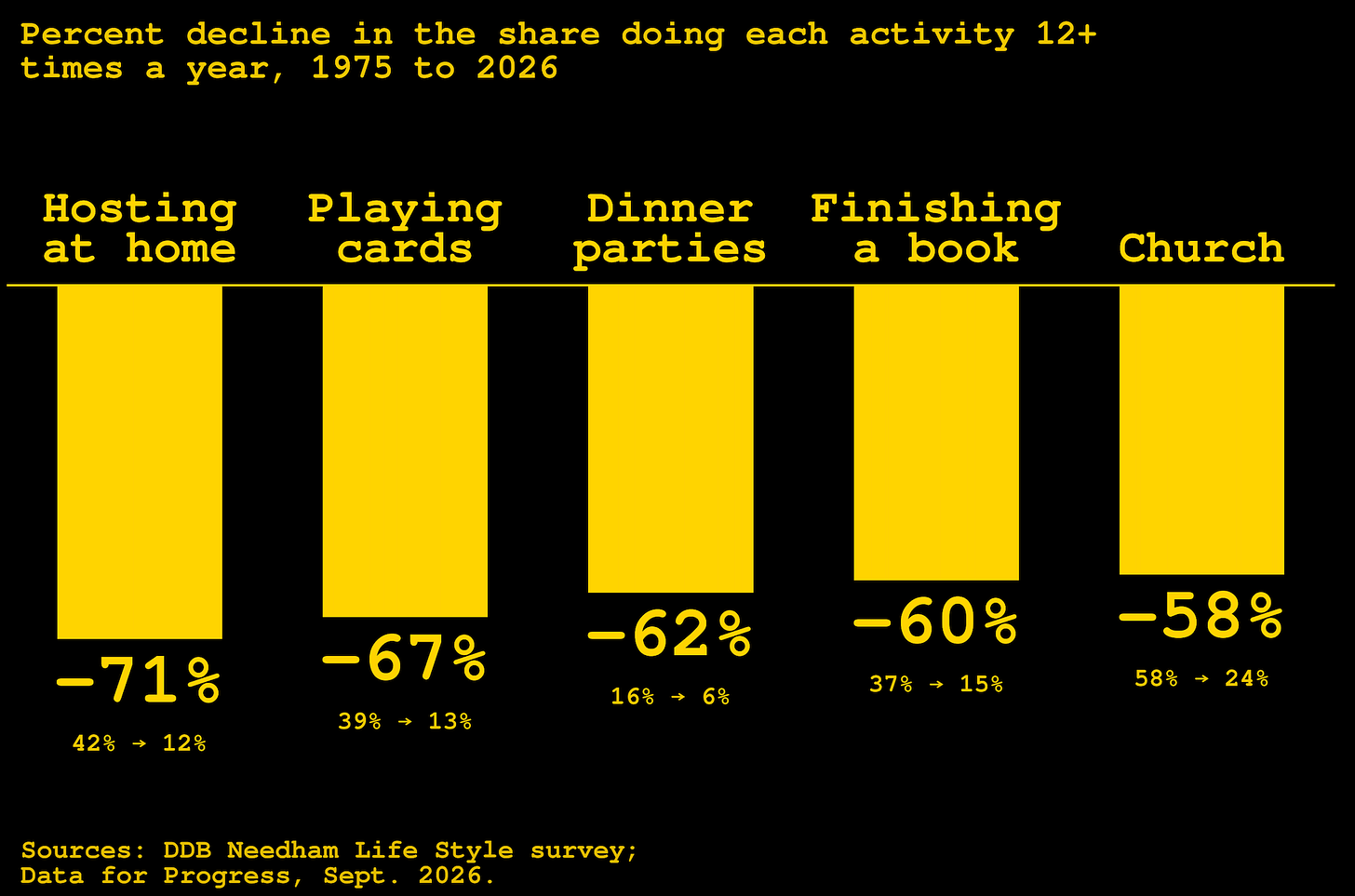
You're No Longer Invited: Last week, I shared a picture of the incredible food spread from a baby shower we attended. I got a few funny responses about how the “food spread industrial complex” has gotten completely out of control.
It's funny how life sometimes sends you signs because two days later I came across an incredible article by Derek Thompson called The Death of the American Host. The basic premise is pretty shocking. In 1975, 42% of Americans said they hosted friends or family at their home at least monthly. Today, that number is 12%.
And we haven’t just replaced dinner parties with meeting friends at restaurants or doing other social activities. We’re spending significantly less time with other people.
Why? Thompson points to a few things. Dual income households are busier and coordinating schedules is hard. Parents spend significantly more time actively parenting their kids. Our friendship networks have gotten smaller. But, I think his most interesting point is also the simplest.
It’s never been easier to be alone. Our houses have become incredible entertainment centers. We can watch Netflix, scroll Instagram, listen to podcasts, order any food we want, workout from home, and entertain ourselves endlessly without interacting with another human.
Compare that to having friends over. You need to find a date that works for everyone. Clean your house. Buy food. Figure out what the kids are doing. Accommodate everyone’s dietary restrictions. And after doing all that work, there’s still a chance the night isn’t that fun.
Or you can sit on your couch and turn on Netflix.
The article got me thinking about the baby shower and the “food spread industrial complex.” I wonder if we’ve unintentionally made the problem even worse.
When did having people over require an incredible spread? Why do we feel like the house needs to be perfectly clean? Why does dinner need to be something special?
Maybe we’re making hosting harder than it needs to be. I love a great dinner party. I love an incredible food spread. I’m certainly not advocating for the death of charcuterie boards....especially when pimento cheese is involved.
But, I want to host more. My wife, Molly, probably reads 50% of my newsletters.......so this is a test! Maybe we should just order pizza, tell our friends to BYOB, and let the kids run around upstairs.

AffordiHome: I can’t be the only person who fantasizes about selling everything and moving to Europe. Buy an apartment on the coast of Portugal. Walk to the coffee shop every morning and read for a few hours. Pick the kids up and head to the beach. Eat dinner outside with friends until 11pm.
Well, if you also fantasize about this life, I have a weekly email newsletter for you. AffordiHome finds wildly affordable houses and apartments across Europe.
Will I actually sell everything and move my family to a small European beach town? Probably not. But, it’s fun to dream for a few minutes every week. You can subscribe here.

We work with a select group of clients to provide tailored, high-touch wealth management. Ready to see how we can help?
Our personalized process ensures you receive expert financial guidance tailored to your unique goals. Get in touch in the way that works best for you—fill out the contact form, send us an email, or schedule a call. However you choose to reach out, we’re here to help you build, grow, and protect your wealth.
VDB Wealth LLC is a registered investment adviser located in the State of Georgia. Registration as an investment adviser does not imply a certain level of skill or training.
The information on this website is for informational purposes only and does not constitute investment, legal, tax, or financial advice. Nothing on this site should be interpreted as a solicitation, offer, or recommendation to buy or sell any securities or investment products. All investments involve risks, including the potential loss of principal.
VDB Wealth LLC provides investment advisory services only to residents of states where it is properly registered or exempt from registration. Past performance is not a guarantee of future results.
VDB Wealth LLC | (415) 209-5862 | contact@vdbwealth.com